Neural Networks
Neural Networks
From Hand Calculations to AI-Assisted Code
Everyone calls a neural network a black box. It isn't — it's a stack of multiplications, a nonlinearity, and one genuinely clever idea for assigning blame backward through the layers. You can already ask an AI to build you one. The problem is knowing why your loss flatlined, why it trains beautifully then fails on anything new, or why the gradients quietly vanished three layers deep — none of which you can diagnose from the outside. This is the course that opens the box.
Five parts, one algorithm, no gaps:
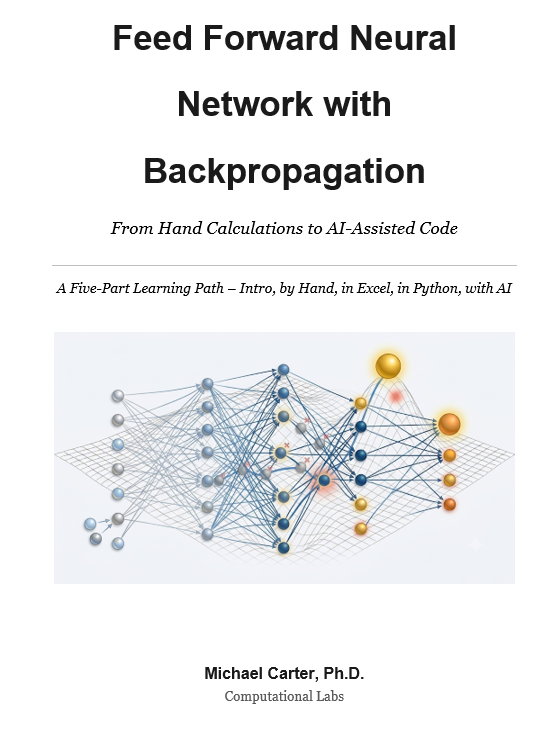
Part 1 — Intro. How layers of simple weighted units, each passed through a nonlinear function, compose into a model that can learn almost any relationship — and why that "almost any" is both the power and the danger. The intuition before the notation.
Part 2 — By Hand. A complete worked example almost no one has ever actually done: a full forward pass, then backpropagation by hand — computing the loss, pushing the error backward, and updating every weight. Every partial derivative, every number shown. This is the step that turns the black box transparent, and it's the reason this course exists. Nothing waved away, nothing left "as an exercise."
Part 3 — In Excel. The same tiny network built out in a spreadsheet you can open and poke at, so you watch the weights update and the loss fall across epochs — and see for yourself what the learning rate and an extra neuron actually do.
Part 4 — In Python. A clean, executable, verified reference implementation — the known-good version you can check any other code against, built up from the same math you just did by hand rather than hidden inside a framework call.
Part 5 — With AI. A tested prompt that directs an AI assistant to carry this same architecture to your problem, plus the understanding to catch it when it's wrong.
By the end you won't just have working code. You'll have followed the network from first principles through a hand calculation, a spreadsheet, and production Python — so when you point an AI at your own problem, you'll know how to read a training curve, recognize overfitting and vanishing gradients on sight, and tell when the answer is right.
Written for practicing engineers and STEM professionals who'd rather understand a method than trust a black box.
