Support Vector Machine
Support Vector Machine
From Hand Calculations to AI-Assisted Code
You can already ask an AI to write you a Support Vector Machine. The problem is knowing why it's overfitting every noisy point, why the wrong kernel turned a strong classifier into a coin flip, or why one slider you didn't understand is quietly trading accuracy for generalization. None of that is visible from model.fit(). This is the course that gives you that judgment.
Five parts, one algorithm, no gaps:
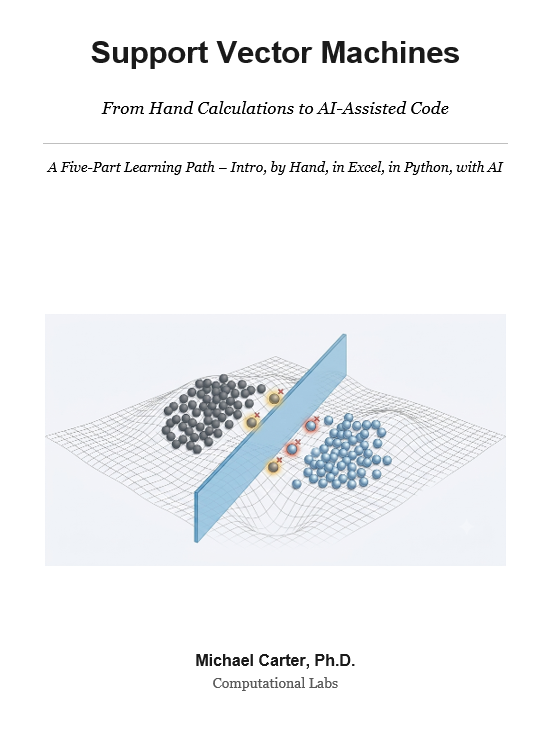
Part 1 — Intro. Why an SVM doesn't just separate two classes but finds the widest possible boundary between them, why only a handful of points — the support vectors — actually define it, and how the kernel trick separates data that no straight line ever could. The intuition before the notation.
Part 2 — By Hand. A complete worked example: set up the margin, identify the support vectors, and solve for the boundary that maximizes the gap — every constraint and every number shown. Nothing waved away, nothing left "as an exercise." You prove the algorithm to yourself.
Part 3 — In Excel. The same example built out in a spreadsheet you can open and poke at, so you see exactly which points become support vectors — and watch the boundary shift as you soften the margin and change the C parameter.
Part 4 — In Python. A clean, executable, verified reference implementation — the known-good version you can check any other code against.
Part 5 — With AI. A tested prompt that directs an AI assistant to carry this same algorithm to your problem, plus the understanding to catch it when it's wrong.
By the end you won't just have working code. You'll have followed the algorithm from first principles through a hand calculation, a spreadsheet, and production Python — so when you point an AI at your own classification problem, you'll know how to choose a kernel on purpose, set C to balance margin against error, and tell when the answer is right.
Written for practicing engineers and STEM professionals who'd rather understand a method than trust a black box.
